How to judge a good office chair: an 8-point check we use ourselves
"Is this a good chair?" is the question we get most. The honest answer is that "good" depends on who sits in it and for how long — but the *checks* are the same every time. Here's the list we run on the floor. You can run it on any sample a supplier sends you, no tools required.
1. Sit down hard. Then lean all the way back.
Don't lower yourself politely. Drop into it the way a tired person does at 5pm. A good chair takes the shock through the gas lift without a clunk. Then lean back to the limit — the chair should hold, not creak, and definitely not feel like it might tip. If the back flexes with a plastic groan, the mechanism or the back frame is under-built.
2. Find the gas lift class.
Lift the skirt and look, or just ask. You want a rated cylinder — SGS Class 3 or 4. This is the single most important safety part of the chair and the cheapest place for a corner to be cut. A supplier who can answer this instantly is a supplier who knows their own bill of materials.
3. Look under the seat at the mechanism.
The mechanism is the metal housing that lets the chair tilt. Cheap ones are thin stamped steel with visible weak welds; good ones are heavier, cleanly welded or cast. Tilt the chair and feel the motion — it should be smooth and even, not notchy on one side. This part decides whether the chair still works in year three.
4. Spin the base and push the casters.
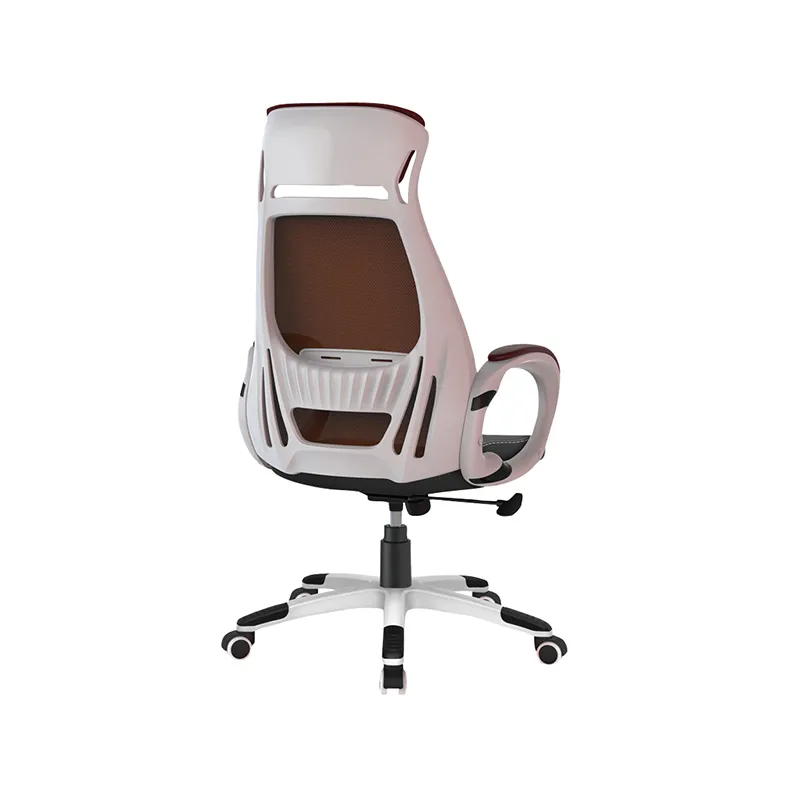
A five-star base should be wide and, ideally, metal (nylon is fine for lighter-duty). Roll each caster — they should turn freely and match your floor (hard casters for carpet, soft for hard floors). Wobbly casters or a narrow base are a tipping risk, full stop.
5. Press the foam, then check the edge.
Press your palm into the seat. It should give and come back, not bottom out onto the board underneath. Then run a hand along the front edge — a "waterfall" edge that curves down is what keeps your legs from going numb. Flat, hard front edges are a cheap-mould tell.
6. Pull the fabric and check the seams.
For mesh: push it — it should be taut and snap back, with no loose weave at the frame. For PU or fabric: tug a seam gently. Loose threads, uneven stitching, or glue squeeze-out at the edges mean the upholstery line is rushing. On a real production run, those small flaws multiply.
7. Work every adjustment.
Raise and lower it ten times. Move the armrests. Adjust the lumbar and the tilt tension. Everything that's *supposed* to move should move smoothly and lock where you leave it. An adjustment that's stiff on a fresh sample will be broken on an old chair.
8. Ask what standard it's tested to.
A serious chair is built and tested to BIFMA — the industry's physical test for years of real use. We run fatigue and load-bearing tests in our own plant for this reason: a chair can pass the eye test and still fail at the 5,000th cycle. You don't need the lab report for a small order, but the supplier should be able to talk about it without dodging.
The one that catches people out
Here's a trap we see a lot: the sample is perfect, the production isn't. A good factory sends a golden sample and then builds 500 to a lower standard. The defence is simple — agree your acceptance standard in writing, and inspect before shipment (AQL sampling). A factory that welcomes inspection is telling you something good about itself.
---
Run those eight checks and you'll know more about a chair than 90% of buyers. If you'd like, send us a competitor's chair you're trying to match, or your target specs and price — email mail@ajrt.net or drop a message on the site, and we'll tell you honestly what's achievable and where the trade-offs are.